
What an Er:YAG Dental Laser Really Is
Erbium lasers changed what a routine filling appointment can feel like. This is a plain explanation of how the technology works, what it is used for, and where conventional instruments still do the job better.
Start With the Name
Er:YAG stands for erbium-doped yttrium aluminium garnet. That is the synthetic crystal at the heart of the device. Fire energy into it and it emits light at a very specific wavelength: 2,940 nanometers, in the mid-infrared range, invisible to the eye.
That number is the entire point. Every wavelength of light is absorbed differently by different materials, and 2,940 nm sits almost exactly at the peak absorption point for water. Shine it at something wet and the energy is consumed immediately in a very thin surface layer. Shine it at something dry and comparatively little happens.
Why Water Absorption Matters in a Tooth
Teeth are not the inert white rocks people picture. Enamel contains a small amount of water, dentin contains considerably more, and decayed tooth structure, which is softened and demineralized, is wetter still. Gum tissue is wetter than any of them.
When an Er:YAG laser pulses against a tooth, the water inside a microscopically thin layer absorbs the energy in an instant, expands, and lifts that layer away in a process called ablation. The laser is not burning or melting anything. It is repeating that micro-removal thousands of times per second while a cooling water spray runs continuously across the surface.
Two useful consequences follow from that mechanism. Nothing touches the tooth, so there is no vibration transmitted into the nerve and no frictional heat building under pressure. And because decayed structure holds more water than sound enamel, the laser removes decay more readily than it removes the healthy tooth around it. The instrument is biased toward the part you want gone.
How That Compares to a Drill
A conventional high-speed handpiece works by mechanical abrasion. A bur spinning at very high speed grinds tooth structure away. It is fast, precise in trained hands, and has been the backbone of restorative dentistry for decades. But grinding produces two byproducts: heat from friction and vibration transmitted straight down into the pulp.
Those byproducts are the reason local anesthetic became standard for fillings. The nerve is not objecting to the removal of decay in principle. It is objecting to being shaken and warmed. Take those two inputs away and the sensation profile of the procedure changes substantially, which is why many patients tolerate laser preparation with no injection at all.
There is a secondary difference worth mentioning for anyone who cares about the longevity of their dental work. A bur leaves behind a smear layer, a compacted film of cut debris on the prepared surface that has to be etched away before a filling can bond properly. Laser ablation does not create one, and the surface it leaves is irregular at a microscopic scale, which is favorable for adhesion.
All-Tissue Means Hard and Soft
Because water is present in both, the same wavelength that removes decay also cuts gum tissue. That is what the phrase all-tissue laser means, and it is why one device can cover procedures that used to require both a handpiece and a scalpel.
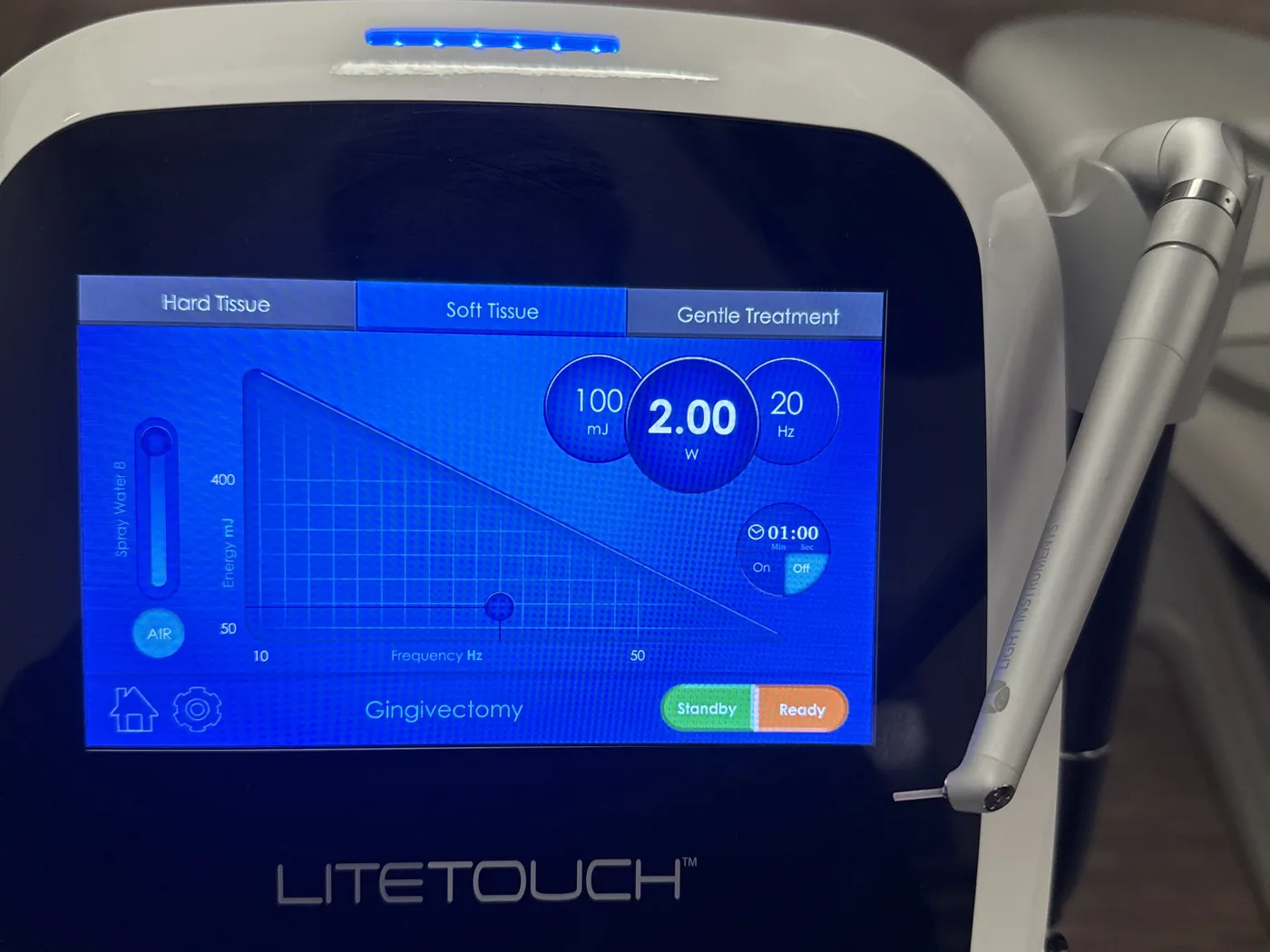
On the hard tissue side, an Er:YAG laser is cleared for caries removal, cavity preparation, enamel etching, and opening pits and fissures before a sealant. On the soft tissue side, it handles gingivectomy and gum recontouring, frenectomy, uncovering partially erupted teeth, and minor tissue removal. Soft tissue work has a bonus property: the laser seals small vessels as it goes, so there is generally less bleeding, which gives the dentist a much clearer view of the outline being created.
What It Cannot Do
Every instrument has a range it works best in, and the laser is no exception.
An Er:YAG laser does not cut metal. Old amalgam fillings, metal crowns, and posts come out with conventional instruments. It is not the fastest tool for full-coverage crown preparation, where a handpiece shapes margins and taper more efficiently. Very deep decay approaching the nerve, and teeth that are already inflamed, generally still call for anesthetic regardless of instrument. And some interproximal surfaces between back molars are simply easier to access with a bur.
Laser preparation can also take somewhat longer on larger restorations. Most patients trade that time willingly for skipping the injection. Some would rather be numb and out in twenty minutes, which is a perfectly reasonable preference.
Is It New?
Not really, and that is a point in its favor. Erbium lasers have been cleared for dental hard tissue use in the United States since the late 1990s, and the clinical literature comparing laser and rotary caries removal now spans decades. What has changed is the engineering. Early units were bulky, slow, and awkward to hold. Current systems are compact, faster, and shaped to handle like a normal dental handpiece.
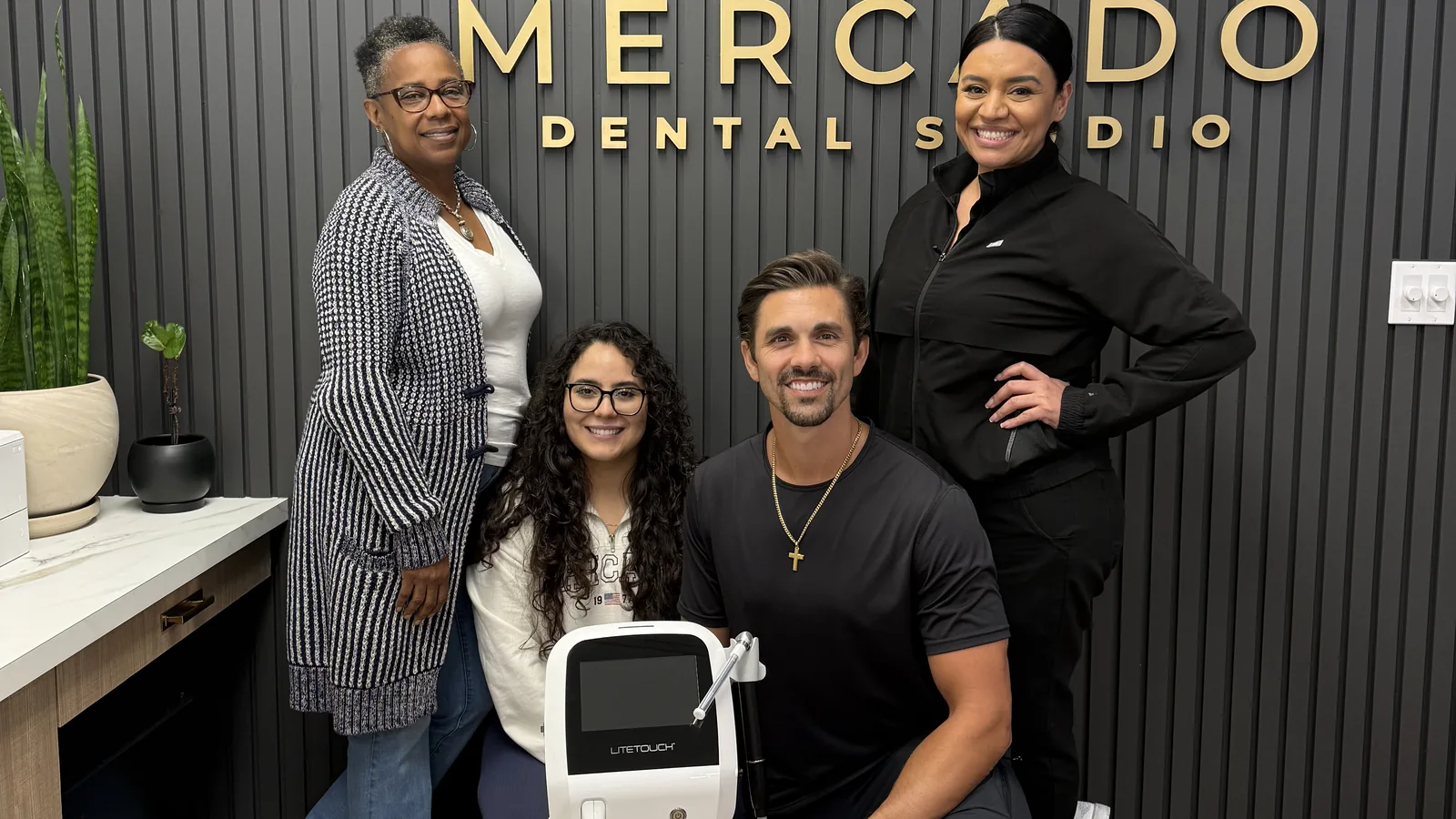
The system at Mercado Dental Studio is the LiteTouch Er:YAG laser from Light Instruments, which is unusual in that the laser source sits inside the handpiece rather than sending the beam down a fiber or through a mirrored arm. Practically, that means a lighter and more direct instrument in the mouth.
Is It Safe?
Erbium dental lasers are regulated medical devices, cleared by the FDA for the procedures they are used for. The main safety consideration is ocular: mid-infrared light at these energies is hazardous to the eye, so everyone in the room wears wavelength-specific protective eyewear, patient included. That is not optional and it is not a formality.
Beyond eyewear, the device is used at settings matched to the tissue being treated, with continuous water cooling. The thermal effect on the tooth is minimal precisely because the energy is spent in the water rather than accumulating in the structure.
What It Comes Down To
An Er:YAG laser is not magic and it does not replace every instrument in a dental office. What it does is remove a specific pair of sensations, vibration and frictional heat, from a specific set of procedures. For a large number of patients that turns out to be the difference between an appointment they dread and an appointment they barely think about afterward.
If you want to know whether a particular tooth is a good candidate, that is a question an exam answers in about a minute. You can read more on the laser dentistry page, or request a consultation and ask Dr. Mercado directly.
Medical disclaimer: This article is for general educational purposes only and is not a substitute for professional dental or medical advice, diagnosis, or treatment. Individual results vary, and no specific outcome is implied or guaranteed. Always consult Dr. Mercado or another qualified healthcare provider about your specific situation. If you are experiencing a dental or medical emergency, call our office or 911.